Giving Strategies for Retirees: Qualified Charitable Distributions (QCDs) [Video]
by Financial Design Studio, Inc. / September 11, 2025Reduce your taxable income in retirement by giving your RMDs to charities . . . these are now called Qualified Charitable Distributions! But it has some particular restrictions that retirees should know before using this strategy. Watch our latest video, or keep reading below, to learn more!
Video Transcript
Here’s a retirement tax strategy that most people, even accountants, overlook. And what I’m talking about are qualified charitable distributions. Hi, my name is Michelle! And I’m a financial advisor here at Financial Design Studio; where we help business leaders choose when they retire. One of the things we focus on is tax efficiency.
Now after they retire, many professionals find themselves paying taxes at the same or higher rates as when they were working. And in retirement, high income means high taxes and high Medicare premiums. But there are strategies to combat this. One of our favorites is Qualified Charitable Distributions (QCD) because you can save in taxes while also giving generously.
What is a Qualified Charitable Distribution?
So first, what is a qualified charitable distribution? This strategy only applies to people who are giving charitably and have money in an IRA that they want to give away. So this is really who we’re talking to. Now, as we start planning for clients, it’s really easy to see when this strategy might make sense.
First we start to look at the expenses that a client is spending. So let’s start here and assume that someone is spending around $100,000 per year in all of their total expenses. And of this amount, let’s say that their living expenses like utilities, gas, things like this, makes up $60,000 of this amount. And then let’s assume that they’re also giving, and that makes up $20,000 of this amount. And then let’s say that travel, let’s say that’s the other $20,000.
This is where and how we start to highlight which strategies might apply to you as a client. So for example, we’ve noticed giving is something they like to do.
And so now, you can do a Qualified Charitable Distribution by selecting what account you give from. You might have a combination of income and investments that you’ve saved for the future, like an IRA, a 401k, maybe even a brokerage account. This strategy only works for you if you have an IRA.
What are the Benefits of Doing QCDs?
Now the benefit of doing a qualified charitable distribution is that this amount that we’re taking out of the IRA can decrease your taxable income. This in turn can decrease Medicare premiums that you’re paying. It can also affect your estate planning. It can benefits you in the sense that you’re able to do some of that giving today that you want to do in the future. So it’s helping you to do it while you’re still alive as well.
How do QCDs Work?
All right, so who can use this strategy? So this is for individuals who are 70 and a half or older. So one of the important pieces for this is it’s not in the year that you turn 70 and a half, it’s once you are 70 and a half or older. So someone who has a birthday in January, for example, would have to wait until July to actually start making QCDs from their IRA.
There a maximum for how much you can do in a distribution. The maximum is $108,000 per year, per person. Let’s say a married couple who likes to give charitably wants to give a lot of money away. The husband can give $108,000 from his IRA and the wife can also give $108,000 from her IRA in 2025. Now this amount is adjusted for inflation each year higher.
And so now let’s just talk about what are the steps of a QCD. So really what you’re doing in order to do a QCD is you are taking money from your IRA and you are sending a check directly to a charitable organization. And this is any organization that is a 501c3 organization. It has to be acknowledged by the IRS that it is a charitable organization.
What are Common Mistakes with Qualified Charitable Distributions?
Not Using an IRA
Well, first of the big ones is that you only take these funds or a QCD from your IRA. It’s very common for people to think, ‘I can give money to charitable organizations right from my retirement account.’ But you cannot do this from a 401k. So it needs to be an IRA only.
Doing Both RMDs and QCDs
Another is that people are doing both a QCD and an RMD. Let’s say that someone has an RMD this year of $50,000 and of that amount, they’re gonna give $20,000 of that away to charitable organizations. A Qualified Charitable Distribution allows you to say, ‘of this $50,000 RMD, I’m gonna take $20,000 as a QCD, and then I’m gonna take the other $30,000 as a taxable distribution to myself.’ If you take your $50,000 RMD in full, but don’t realize you can deduct your giving, you are paying more in taxes than you have to. So this is where it can really add up.
Roth Conversions
Another common mistake is doing Roth Conversions. If someone wants to give all of their money to charitable organizations, Roth conversions don’t help their plan. Someone giving all their money away will never pay taxes on those funds anyway, nor will the charities they want to give the money to. So why would you do Roth conversions today to pay taxes on that when you don’t need to?
Not Deducting
And then the next mistake can be not doing a QCD and not deducting those funds either. So someone who is not doing a QCD is just giving money from their checking account. In order to have deductible charitable contributions, you need to be itemizing on your tax return. And that means they need to have itemized deductions of over $15,750 for individuals and for married couples over $31,000.
This is where you can see you need to have significant itemized deductions if you’re not doing a QCD. So someone who is just doing maybe a donation of $5,000 a year, they might not even be able to deduct that on their tax return if they don’t even realize QCDs are a strategy.
The mistake is they’re missing out on actually both the potential to do the QCD and decrease their income. And they’re not even able to deduct that charitable contribution because their itemized deductions aren’t high enough. So they’re missing out completely on strategic side of charitable giving.
Too Early
And then finally, the last mistake can just be that people that are doing it too early. So 70 and a half is an age where most people are already maybe two to three years in retirement.or maybe well into retirement. so 70 and a half, you can think, ⁓ well, I’m retired. I can do these QCDs. However, you do have to wait until you’re 70 and a half to start them, and then you can do them any time after.
Retirement Planning Next Steps
So if you’re starting to plan out your retirement, that’s who we help best. Our team specializes in comprehensive financial planning and investment management, so you stay on track all year, every year. Reach out to our team by clicking “Get Started” to schedule a 30-minute consultation about your retirement plan. We’ll see you there or in the next video.
Thanks for watching!
Bonus: Retirement Planning Guide
Ready to take the next step?
Schedule a quick call with our financial advisors.


Recommended Reading
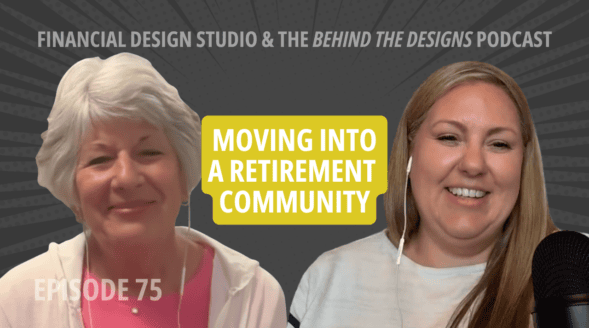
Ep 75: How to Decide When to Move into a Retirement Community
In this episode, Michelle interviews Royce on the process of downsizing, picking the community, and what her family's experience has been.

Ep 69. What You Forget to Plan for, Until After Your Spouse Passes
In this episode, we helped our fictional client Renee, take control of her retirement plan after her spouse passed.
Financial Design Studio, Inc.
We are financial advisors in Deer Park and Barrington, IL. A team with a passion for helping others design a path to financial success — whatever success means for you. Each of our unique insights fit together to create broad expertise, complete roadmaps, and creative solutions. We have seen the power of having a financial plan, and adjusting that plan to life. The result? Freedom from worrying about the future so you can enjoy today.