
How Will AI Affect the Jobs Market?
by Financial Design Studio, Inc. / April 15, 2026
There has been an interesting shift in the conversation about Artificial Intelligence (“AI”) since late 2025. Initially, investors were entirely focused on the potential build-out of AI and identifying the primary beneficiaries of that trend. The stocks of Nvidia, Google, and many others surged as a result, which we wrote an article on at the end of last year. But since the start of the year, we’ve seen investors question which business models AI may negatively impact. Stocks in companies seen most exposed to AI replacing what they do have come under pressure. This has led to inevitable questions about how AI might affect the jobs market for white-collar workers. While we don’t have a crystal ball to predict how AI will affect jobs and the economy, this article talks about the potential risks and rewards of AI.
AI & Jobs: Engagement-bait or Actual Risk?
Purported AI experts have written several articles this year that paint a very negative picture of how AI will affect the jobs market. Social media being what it is, it’s important for you not to assume that every “prediction” is being made with good intentions. As I’ve seen, read, and reviewed these types of articles, I’ve noticed a trend:
- An article written by an AI insider paints a negative future of AI’s impact on jobs and the economy.
- Because an “insider” wrote the article, well-known people outside the AI ecosystem re-post the article with comments like, “Wow, this looks bad!”.
- 24 hours later, articles from other AI insiders come out criticizing the original author’s conclusions and intentions.
- Rinse and repeat.
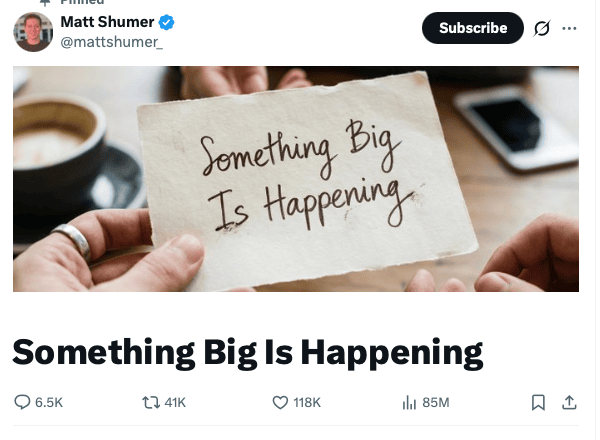
Just in the last six weeks, I’ve encountered a half-dozen such articles on Substack and other platforms. At first blush, I had the same reaction as many others; “That doesn’t sound good.” But after hearing counter-points to the articles and thinking through it myself, the negativity of the original article seems overblown. We also have to keep in mind that on platforms such as Substack, writers are motivated to get clicks because that’s how they get paid. Fear-driven articles sell a lot more than happy ones do. “Clicks for money” is one of the biggest scourges of social media.
So if you’re coming across articles on LinkedIn talking about how AI will destroy jobs in your industry, keep these motivations in mind. Don’t be quick to dismiss AI’s future impact, but don’t ignore it either. There are genuine risks and opportunities with AI that we all need to be aware of. Part of our job as financial advisors is to keep our clients updated on these issues. That’s why keep our nose to the ground on the news, and why we write these articles, post videos, and send exclusive emails to our clients!
AI Models are Rapidly Progressing
If you’re like me (i.e. over the age of 50) you may have dabbled using AI when it first came out. I thought it was a neat tool that actually helped me solve some problems I had getting my computer to do things I wanted it to do. Being completely inept at programming, AI empowered me to get these things done.
But further use of AI revealed many weaknesses. I noticed it would make things up about topics I already knew about. Worse, I caught AI flubbing basic math problems, called it out, only to have it respond, “Whoops, you’re right!” Hence I set it aside thinking it’s interesting, but not world-changing.
Yet in the last few months, Open AI (ChatGPT), Google (Gemini), and Claude have all rolled out more advanced models that by every indication are leaps and bounds better than previous models. It’s hard to notice the improvement because the latest models are only available to people who pay to have access to them. Casual users of free AI versions are still using older models.
Admittedly, I’m not deep in the weeds using the latest models to write computer applications or send rockets to the moon. But even I have seen a marked improvement in the results I’m getting when using AI. Topical research results are much better and well-sourced, replacing hours of hunting through Google searches. And I’ve been able to streamline tedious tasks, not just by asking AI how to streamline the task but have it actually do it for me.
The point that ‘doomsday’ articles make about the rapid improvement in AI models seems true. Further, the improvement appears to be speeding up, helped by AI figuring out how to make itself better. And if that’s the case, it’s incumbent upon us to think about how AI will affect the jobs market… and more specifically our jobs and lives.
Investors are Pricing in AI Risks
As the AI debate moves into this new phase, investors are scrutinizing business models that might be at risk from AI disruption. From the start of 2026, the Software as a Service (SaaS) model has been front and center of worries about AI. Many investors have gravitated towards these stocks in the last 10 years as they saw them as having an impenetrable “moat,” driving their valuations to historically high levels. Companies like Intuit and Adobe fit this bill. The software ETF (Ticker: IGV) shows how concerned investors have become since the start of the year.
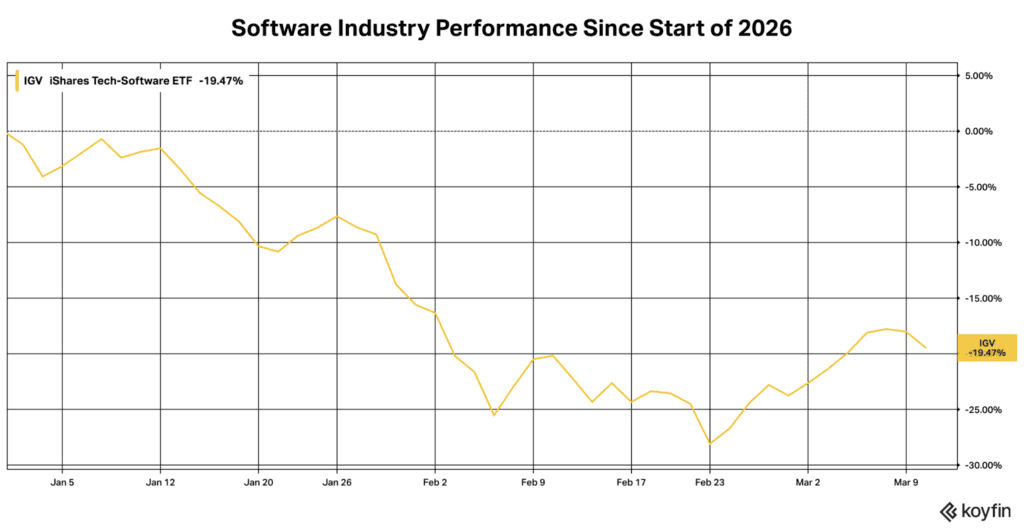
AI worries haven’t affected only the software industry. As models rapidly improve, newly perceived threats are emerging. Insurance brokers, freight logistics companies, and even real estate management companies have seen stocks come under pressure as investors speculate that AI will replicate what they do for a lot less money.
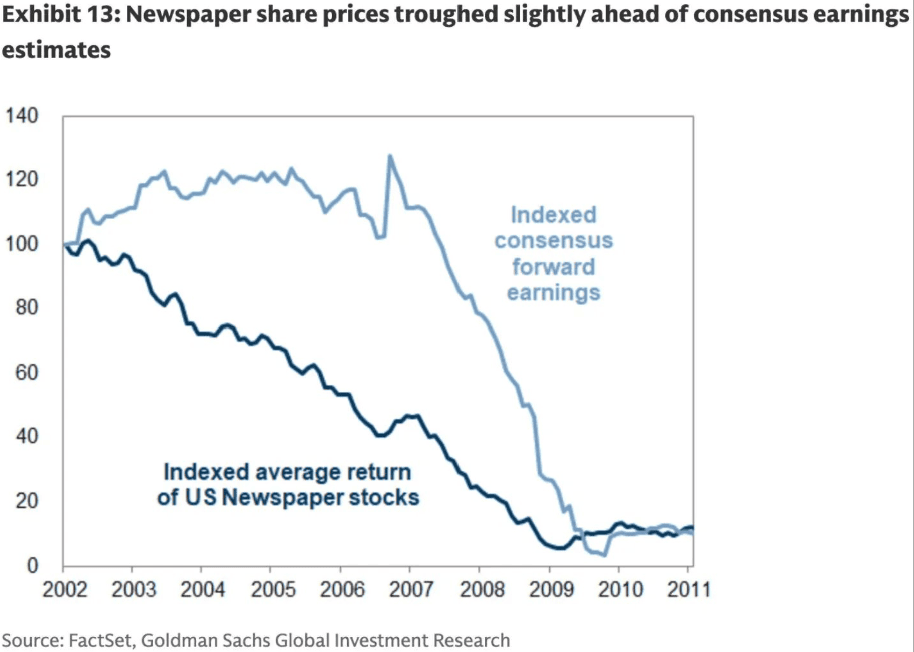
Bulls in these stocks will look at stable earnings trends as evidence the moats are stronger than the market believes. And they may be right – for the time being. But it’s clear that things are changing and how these companies adapt to this new world will be important to follow. Just ask newspaper companies from the early 2000s. Their stocks came under pressure as the internet threatened their existence, even though earnings held up well for several years, before collapsing. These are the kinds of historical patterns we are watching as we manage client portfolios.
How are CEOs Reacting to AI Risks?
While stocks have only recently come under pressure from AI risks, management teams are reacting. During fourth quarter 2025 earnings conference calls, many CEOs and CFOs mentioned that they’ve been able to trim IT departments because of AI productivity gains. This is what scares most people about how AI will affect the jobs market.
One high profile CEO reaction came from former Twitter founder Jack Dorsey, who currently runs the payments company Block. He announced Block would cut half its staff “because of AI.” There are plenty of questions about Dorsey’s credibility, but it’s notable that Block’s stock (Ticker: XYZ) rose 20% on the announcement.
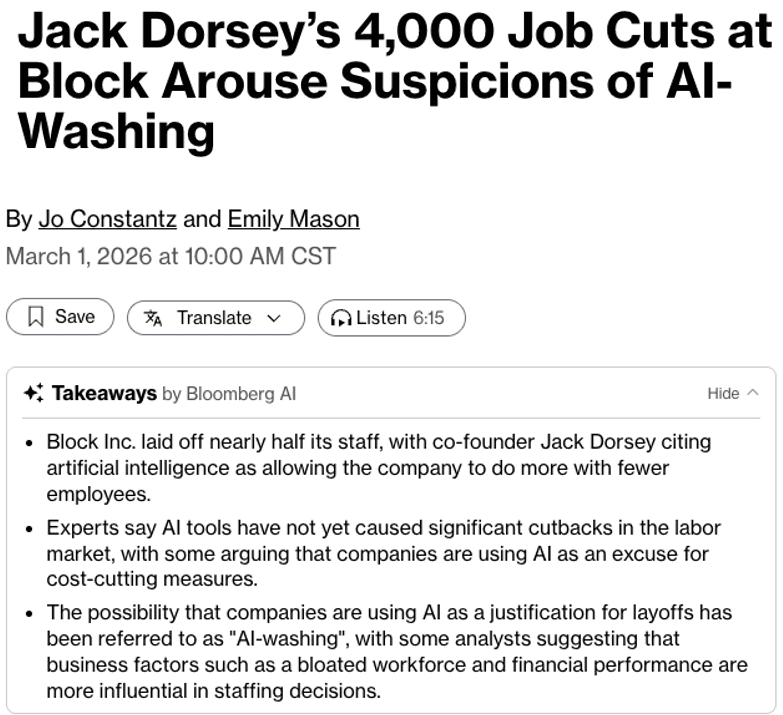
While this announcement may just be a “one-off” event, CEOs have a herd mentality. Given the stock’s jump on the layoff announcement, there’s little doubt that corporate boards will place the topic of staffing levels and AI on the agenda going forward. We don’t say this to be alarmist, but to highlight how quickly the conversation around AI is developing.
Beware Zero-Sum Thinking about AI’s Impact on Jobs
Now let’s talk about AI realities. Most of the doomsday articles you read have one thing in common: zero-sum thinking. What I mean by that is they focus on specific tasks that AI will clearly be able to do better than a human, and assume that because of that, the human is made obsolete. Examples of this type of thinking assume that the advancement will relegate graphic designers to working as baristas because AI can create cool, detailed imagery.
There are plenty of historical examples of technological advances rendering old ways obsolete. But ultimately, new technologies were beneficial for society and workers adapted to them. No doubt the “Charley” who drove Wells Fargo stagecoaches by horse got nervous when workers were laying down train tracks in his delivery area. But that advancement in shipping products created lots of jobs in manufacturing that couldn’t exist without that advancement.
AI will probably displace some types of jobs, but will open up new opportunities that currently don’t exist. It’s those “unknown” opportunities that will create alternative employment and expand possibilities for others that remain in their jobs. Never bet against human ingenuity and ability to adapt.
Legal & Regulatory Risks will Tame AI Adoption Rates
Another error I see AI doomsters make is the belief that we can just snap our fingers and do the same things with AI as we currently do with human workers. When new technologies emerge, there are always early adopters. And these early adopters will start using the new technology without thinking about the second and third-order effects of what they’re doing.
Industries such as healthcare and finance have strict regulations around customer data privacy. Did you know that free versions of AI learn and improve based on what users are asking? If a user is sharing private customer information or a company’s trade secrets, the AI is keeping that information so it gives better answers in the future, potentially exposing secret information. Companies are just now getting around to reigning in the usage of AI by their early adopter employees.
Legislators create regulatory frameworks not only to protect consumers but to create chains of enforcement, reviews, and accountability. How do companies monitor employee usage of AI if there aren’t acceptable use policies in place with the ability to review that employee AI usage? If a company is quickly adopting AI and AI makes a mistake, who’s held responsible for that?
From our seat, we are only now seeing companies wake up to how unmonitored AI usage by employees puts the company at risk of running afoul of established regulatory standards. AI will no doubt lead to huge productivity gains in the future, but we are likely entering a phase where companies slow things down so their policies and procedures can catch up to the new technology.
How Will AI Affect the Jobs Market?
A better title for this article may have been, “How will AI affect MY job?” That’s the real question more people are asking themselves. Clearly there are risks to AI taking over certain jobs and industries that previously relied on human capital to produce goods and services. But there are also a lot of reasons not to become too pessimistic.
First, while AI adoption and model improvement feels quick, companies will not allow employees to use AI willy-nilly. We will hear a lot more about AI companies adopting policies and procedures over the next two years, which inevitably slows down adoption rates.
Second, while AI is a powerful tool, there are limits to what it can do. Trades people that work in the physical world fixing things will still see demand for their expertise even if the customer is empowered with more information thanks to AI. AI may tell me exactly how to fix a leaky faucet, but there’s no way I’m going to actually do it myself!
At the end of the day, if this question is keeping you up at night, might be time to delegate worrying about your finances to someone else! Our job as financial advisors is to build you a plan that can adapt to an unpredictable economy. You shouldn’t have to worry that losing your job will set your retirement plan off track. If you want this kind of confidence in your retirement plan, reach out to our team to schedule a free 30 minute introduction call to see if we are a fit for you!
What’s Next For AI?
Lest we forget AI output depends on human input. While AI zealots like to talk about generative intelligence, the fact remains that humans have to ask AI to do what it does. And when you boil down many executive-level white-collar jobs, what the executive is ultimately responsible for is making executive decisions. Is a CEO really going to prompt ChatGPT for a new marketing strategy and then hold ChatGPT accountable if the strategy fails? Hardly.
Since we have many clients that haven’t retired yet, this article brings this conversation to the forefront. AI capabilities are improving rapidly. And like it or not, that forces all of us (including me) to examine the value we bring to our customers beyond providing answers that customers can now get from AI.
But as I said earlier, let’s not solely focus on the risks from AI. This is an amazing new technology that is going to allow all of us to do things we didn’t think we were equipped to or too old to do. Embrace it. Start by thinking about the most time-intensive, mind-numbing tasks you do and ask AI if there are better ways to do those things. You may be surprised and inspired by what it says.
Bonus Resource: Our Free Retirement Planning Guide!
Ready to take the next step?
Schedule a quick call with our financial advisors.


Recommended Reading
FDS Newsletter: Third Quarter, 2026
FDS Newsletter: Third Quarter 2026 | AI Buildout Compared to History | Open Enrollment | Impacting Beneficiaries | Team Interview

Financial Design Studio, Inc.
We are financial advisors in Deer Park and Barrington, IL. A team with a passion for helping others design a path to financial success — whatever success means for you. Each of our unique insights fit together to create broad expertise, complete roadmaps, and creative solutions. We have seen the power of having a financial plan, and adjusting that plan to life. The result? Freedom from worrying about the future so you can enjoy today.
The AI Capital Spending Boom: Historical Parallels & Market Risks
Is the AI capital spending boom a bubble? We compare the massive $1 trillion spending surge to historical tech booms to identify risks.