
The AI Capital Spending Boom: Historical Parallels & Market Risks
by Rob Stoll, CFP®, CFA, Financial Advisor & Chief Investment Officer / October 8, 2026
There are a lot of questions recently about whether “Artificial Intelligence is in a bubble?” Our newsletter article from late 2025 addresses whether AI-related stocks were showing “bubbly” characteristics. We concluded that “…there is an elevated risk of correction in these stocks.” So far in 2026, the only major AI correction has been in stocks that seem to be most at risk of AI hurting their business. This quarter’s article looks at the AI bubble question from a different angle: that being the economic impact of a historic capital spending cycle. There’s no doubt that AI spending is the primary driver of U.S. economic growth. But instead of trying to predict how AI will play out in the coming years, we think a better approach is to examine the evolution of prior investment booms, which can inform us how the current boom may play out.
Key takeaways:
- In 2026, companies will likely spend over $800 billion on the AI build-out, and they will invest an additional $1.2 trillion annually from 2027 to 2030.
- The economic impact of the current AI spending blitz exceeds that of the railroad build-out of the late 1800s, the interstate highway system of the 1950s and 1960s, and the internet build-out of the late 1990s.
- Hyperscaler companies issuing debt is a warning sign that the spending cycle may be extended.
- While strong hyperscaler cash flows offer a cushion, the reliance on Special Purpose Vehicles (SPVs) may signal late-cycle overextension.
How Much Are Hypercalers Spending on Artificial Intelligence?
The pace of investment spending on artificial intelligence is rising rapidly. Analysts are having a hard time to pinning down exactly how much they are spending. The easiest metric to look at is what so-called “hyperscaler” companies are committed to spend on these investments, as these are numbers that matter to investors. The five companies classified as hyperscalers are Alphabet (Google), Amazon, Meta (Facebook), Microsoft, and Oracle. Looking solely at the five companies in the chart below, we see that spending has risen from $200 billion in 2024 to an estimated $800 billion in 2026, with expectations for spending to exceed $1 trillion in the coming years.
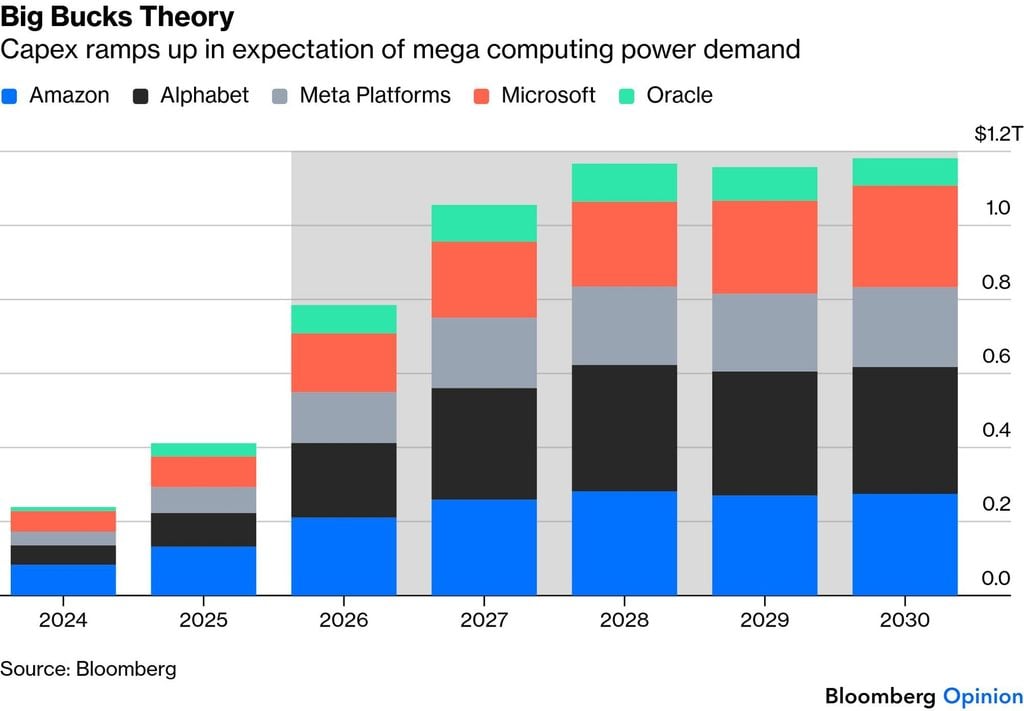
These estimates likely underestimate the scale of investment spending. Not included above are Anthropic, which launched the Claude platform, and OpenAI, which launched ChatGPT. Spending by these two companies likely approaches $100 billion per year. Beyond direct AI companies, Standard & Poor’s expects that electric utility companies will more than double capital spending (to $280 billion) relative to when ChatGPT was first launched. More electric generation means more spending on transformers, gas turbines, and the like.
Regardless of the exact number, the takeaway is that the sheer size of spending is very large and continues to grow. Just one year ago, hyperscaler companies estimated spending $400 billion in 2026. The actual number for 2026 is now twice that! The question is how long this spending will continue. Most observers believe spending levels will remain substantial in the current build-out phase, but decline as AI capacity comes online. But no one is sure when the spending push will end.
How Does the AI Spending Boom Compare to Other Tech Revolutions?
Over $1+ trillion dollars is clearly a lot of money. By comparison, the United States spends $1 trillion on defense, $1.1 trillion on Medicare, and $1.6 trillion on Social Security. Given the scale of AI spending, AI has evolved from a stock market story to a major driver of the U.S. economy.
The current economic output of the United States is $32 trillion per year, which economists call Gross Domestic Product (“GDP”.) Assuming a flat $1 trillion of spending on AI equals 3.1% of total economic output. Researchers from Columbia Business School have looked back over the history of the United States and think the size of the AI spending boom exceeds that of the past build outs of railroads, highways, and fiber optic networks.
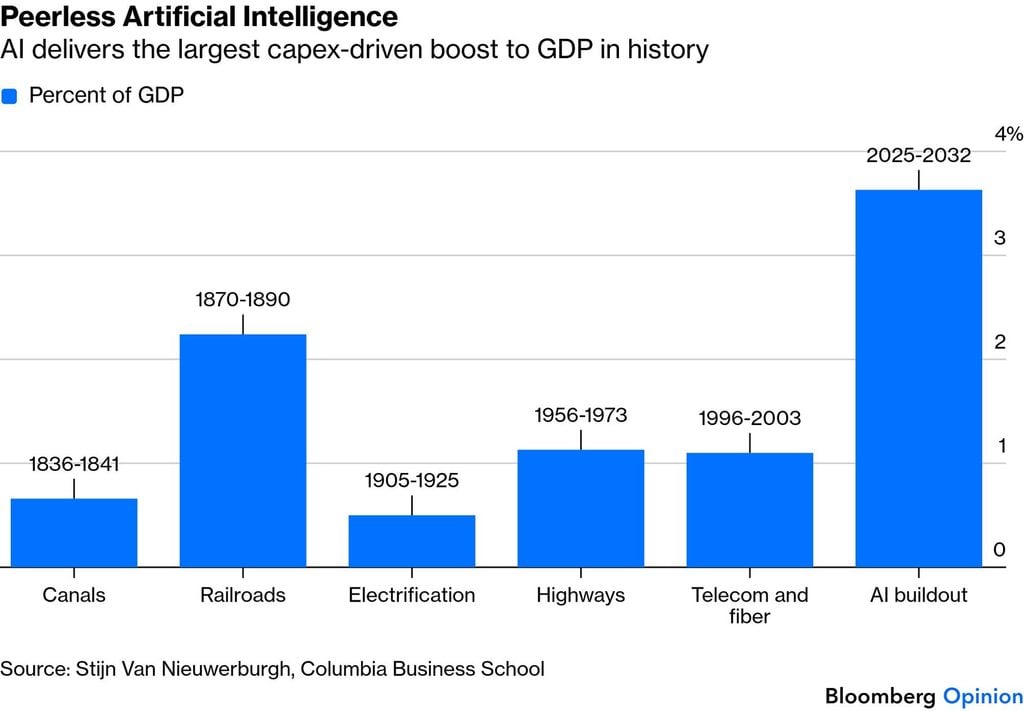
This is an important historical context. While each of the revolutions had a meaningfully positive impact on the long-term growth of the U.S. economy, the business cycles during the build-out phase were anything other than smooth. The U.S. suffered from two panics in 1873 and 1893, both of which were directly related to excessive speculation in railroads. The tech bubble of the 1990s ended similarly, with many internet companies going bankrupt. In both situations, the installed railroad track and fiber optic cable ultimately saw profitable use, but many investors experienced disappointment due to the early and frequent spending.
We believe the massive surge in AI spending is a “warning sign” to keep an eye on. Significant capital spending on new technology can have an outsized impact on the overall economy. And when that spending cycle encounters difficulties and stalls, history tells us that it can have a negative impact on the same economy.
How Increasing AI Debt Signals Growing Market Risk
If the economic impact of surging AI spend is the first indicator we’re watching, how that spending is being financed is the next most important indicator on our radar. From 2023 to mid-2025, almost all of that spending was financed by internal cash flows at hyperscalers. Google, Amazon, Meta, and Microsoft all have strong, growing underlying businesses outside of AI. Cash generated from these “Golden Geese” was increasingly plowed into spending on AI.
However, the spending splurge is so large now that it has overwhelmed these company’s ability to finance the projects with internal cash flows. Companies that were using own cash flows to repurchase their own stock are now being redirected towards AI spending. Most notably, however, is the fact that these companies are now issuing massive amounts of debt to finance the build-out, as this chart from JP Morgan Asset Management shows.
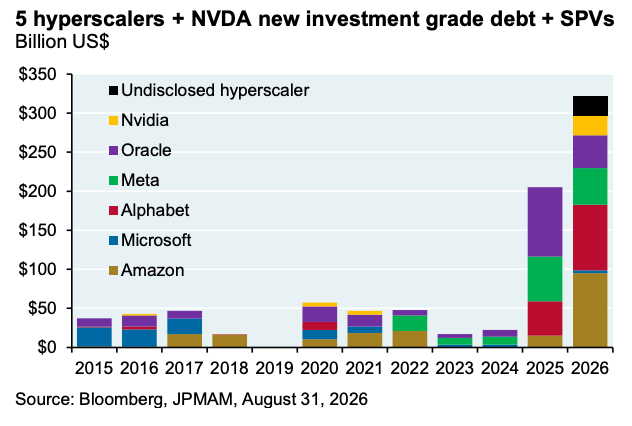
Going back to the historical revolutions noted above – railroads of the late 1800s and internet build-out of the late 1990s – both of those bubbles eventually hit a wall due to surging debt issuance. Stock investors have a tendency to look the other way as companies spend cash flows on major investments. But bond investors are very particular about getting their money back. If bond investors lose confidence in the ability of companies to pay back their debt, they can quickly shut the window on these companies being able to finance their spending in the bond market.
What Are “Special Purpose Vehicles”?
Our view is that we are still in the early stages of this new wave of debt issuance. While nearly $500 billion of debt issued since mid-2025 sounds like a very large number, it’s still small in the context of $11.7 trillion of corporate debt outstanding. However, we believe the pressure on companies to “spend or fall behind the AI race” will lead these same companies to keep pushing the debt issuance envelope.
One other thing concerns us about surging debt issuance. If you look at the chart above, you’ll see the acronym “SPV” included in the list of entities raising debt. SPVs are “Special Purpose Vehicles.” Having gone through two major investment cycles in my 29-year career, SPVs typically arrive late to the party, serving as a classic sign of cycle overextension.
We saw this with the tech and telecom build-out of the late 1990s and definitely saw SPVs come out of the woodwork to buy bad mortgages during the late 2000s housing bubble. SPVs by nature are opaque and are most often “off-balance sheet entities” whereby it’s hard to determine exactly who is on the hook to pay debts if they go bad. In my view, the fact that SPVs are playing a greater role in the AI build-out is a red flag.
How is the AI Cycle Different from the Railroad and Internet Buildouts?
While the size of spending and how the spending is being financed raise some historical eyebrows, it’s important to distinguish the current cycle from those prior ones. We believe – at least for now – there is some cushion. The chart below is a historical look at trailing 12-month hyperscaler cash flows. The main reason why we aren’t too concerned right now is that the core businesses of the biggest AI spenders are strong. Look at the green line, which represents the sum total of operating cash flows for these five companies. The numbers are A) massive, and B) still growing.
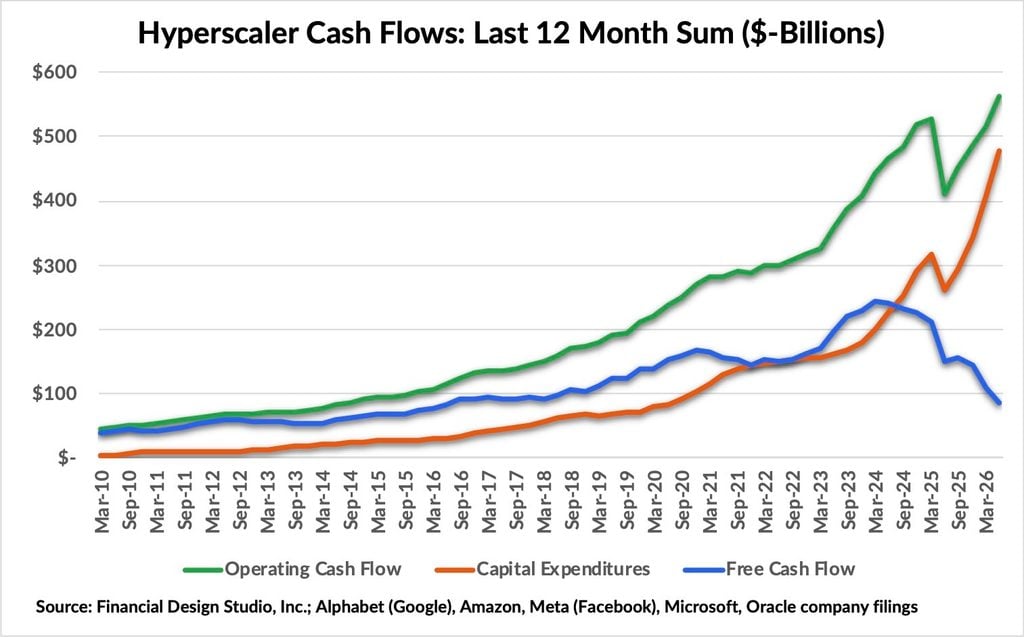
The majority of investors fixate on what’s called Free Cash Flow (“FCF”,) which takes Operating Cash Flow minus Capital Expenditures. FCF has declined meaningfully since 2024 and has led to modest performance of these stocks over the last year. For much of the last 15 years, investors gravitated toward large tech stocks due to their belief that their business models were “asset-light.” Meaning, they were very profitable and those profits could be allocated to buying back stock, which creates strong buying demand for their stocks. The AI spending surge has reallocated those cash flows away from buying back stock and towards capital spending with an uncertain future payoff.
In prior historical cycles, both railroads of the 1800s and newfound “fiber” companies of the late 1990s spent a lot of money before they had real business profits from these ventures. The gap between spending and eventual profits can be much wider than what these initial investors hope, causing bankruptcies. And while we have our share of new companies on spending binges without strong cash flows (Claude & ChatGPT, for example), most of the spend is from these very profitable hyperscalers.
What’s Next for the AI CapEx Cycle?
Predicting the timing and “what happens next” of the AI CapEx cycle is highly uncertain. But we believe that history is a great guide for what comes next, and hence we believe this spending cycle will end at some point.
We believe there will eventually be a moment when one of these hyperscalers ‘pushes back from the table’ by announcing a curtailment in capital spending. Maybe because they don’t think they’ll get the investment returns they hoped for, or because they simply can’t get the money to finance the continued spending spree. Such a moment might be closer than many expect, given the surging costs of building data centers.
A hyperscaler ‘push back’ will probably be profoundly negative for the recipients of all this capital spending – Nvidia and semiconductor stocks. These are the companies whose earnings expectations have gone sky high as demand for AI and semiconductor chips has surged. But it could also be a relief to investors in hyperscaler companies, as curtailment of AI spending would mean spending operating cash flows on stock buybacks.
What Does This Mean for FDS Clients?
We are closely watching all parts of our investment models to see how the AI spending surge can impact our client’s investments. Many traditional stock benchmarks, such as the S&P 500 and MSCI Emerging Markets Index, have become very undiversified. So we have taken steps to enhance diversification in those asset classes. Likewise, we are keeping an eye on exposure to AI-related bonds in portfolios.
Our objective is that client portfolios generate the long-term returns they need to support future spending needs, while experiencing less volatility than standard benchmarks. Investing in different types of stocks and bonds – called diversification – is how we do that.
Markets and the economy are always in some state of transition from boom to bust and everything in between. We partner with you, monitoring your hard-earned savings and optimizing your investments for any environment.
If you are nearing retirement and you don’t want the pressure of “getting it right,” we would love to work with you. Our team specializes in retirement planning for professionals who have executive compensation, and who want tax efficient investment management. Schedule a 30 minute introduction call to see if we are a fit.
Bonus Resource: Our Retirement Planning Guide!
Ready to take the next step?
Schedule a quick call with our financial advisors.


Recommended Reading
FDS Newsletter: Second Quarter, 2026
FDS Newsletter: Second Quarter 2026 | Interest Rates and the Budget Deficit | Social Security | Team Interview

Rob Stoll, CFP®, CFA, Financial Advisor & Chief Investment Officer
Rob has over 20 years of experience in the financial services industry. Prior to joining Financial Design Studio in Deer Park, he spent nearly 20 years as an investment analyst serving large institutional clients, such as pension funds and endowments. He had also started his own financial planning firm in Barrington which was eventually merged into FDS.
FDS Newsletter: Third Quarter, 2026
FDS Newsletter: Third Quarter 2026 | AI Buildout Compared to History | Open Enrollment | Impacting Beneficiaries | Team Interview